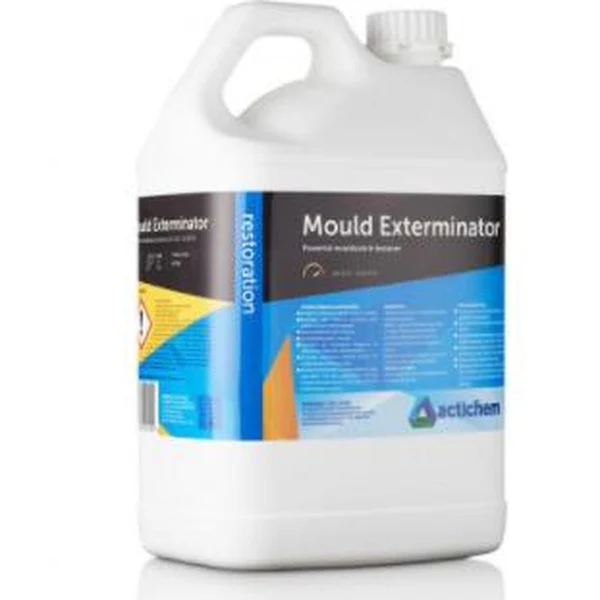
Application Areas and Surface Suitability
Ideal for use in uninhabited buildings, strip-outs, sub-floors, external walling, landscape structures, roofs and pathways. Suitable for natural stone, ceramic and porcelain, concrete and masonry, and timber.
Do not use or allow contact on carpets, fabrics or sensitive surfaces. This is Actichem’s own restriction and it matters here, because Mould Exterminator sits alongside carpet and upholstery chemistry in our range. It is a hypochlorite bleach and will strip dye and damage fibres. For mould odour and staining on textiles, ask us for a textile-appropriate product instead.
Benefits
- Disinfects bio-contaminated surfaces.
- Kills mould (including roots and hyphae) and removes the staining.
- Penetration — to provide complete mould removal of target surfaces, this powerful anti-microbial package has been combined with super-wetting technology. This enables the Hypochlorous Acid to penetrate faster and deeper into the inner structure of fibre and porous substrates.
- Cleaning — Mould Exterminator also provides outstanding cleaning power to remove the accompanying organic grime.
- Almost instant stain removal with no scrubbing.
Safety
Please read this section even if you have used this product before. Earlier versions of this page described Mould Exterminator as a safe product and carried no hazard information. That was wrong, and we have corrected it.
Mould Exterminator is classified as a HAZARDOUS CHEMICAL and DANGEROUS GOODS under the Model WHS Regulations and the ADG Code. It is a Poisons Schedule 6 substance.
- Signal word: DANGER
- H314 — causes severe skin burns and eye damage
- H335 — may cause respiratory irritation
- H290 — may be corrosive to metals
- AUH031 — contact with acid liberates toxic gas
- GHS: Skin Corrosion/Irritation Category 1B; STOT Single Exposure (Respiratory) Category 3
- HAZCHEM code: 2X
- pH as supplied: 11.9
- Active: sodium hypochlorite, less than 10%, with sodium lauryl ether sulphate and a proprietary surfactant
Personal protective equipment. Elbow-length PVC gloves; chemical goggles wherever there is any chance of eye contact; overalls and a PVC apron. A PVC protective suit may be required where exposure is severe. Access to an eye wash unit and a safety shower is specified by the SDS. H314 means this product causes irreversible eye damage and burns skin — the goggles and gloves are not a formality.
First aid — eyes. Immediately hold the eyelids apart and flush the eye continuously with running water for at least 15 minutes. Obtain medical attention without delay.
First aid — skin. Remove contaminated clothing immediately. Flush skin and hair with running water and soap. Seek medical attention if irritation occurs.
First aid — inhalation. Remove the person from the contaminated area to fresh air and keep them at rest. If breathing is difficult, transport to hospital without delay.
First aid — ingestion. Do NOT induce vomiting. Rinse the mouth with water, give small amounts of liquid, and seek medical advice.
Storage. Store in a cool, dry, well-ventilated area. Do not store near acids or oxidising agents. The product may be corrosive to metals — do not decant into or store in unlined metal containers.
Never Mix With Acid
Mould Exterminator liberates chlorine gas on contact with acid (AUH031). Chlorine gas causes severe respiratory injury and can be fatal in a confined space such as a bathroom, shower recess, sub-floor or plant room — exactly the places this product is used.
Never mix Mould Exterminator with, and never allow it to pool into, run into or share equipment with, any of the following acid products we also supply:
Also never mix with ammonia or ammoniated cleaners, which form chloramine gas with hypochlorite — a gas that causes severe respiratory injury and can be fatal in a confined space such as a bathroom, sub-floor or roof cavity. In our own range that means Actichem Bust and Actichem Protein Spotter, both alkaline ammoniated spotters commonly carried in the same kit as a chlorine product. It also includes household ammonia and many glass and multi-purpose cleaners. Never spray one onto a surface still wet with the other. If an acid step and a chlorine step are both required on the same job, rinse thoroughly with clean water between them and use separate, clearly labelled equipment.
Specifications
| Actichem product code |
AP726.05 |
| Pack size |
5 litres |
| Dilution |
Ready to use — do not dilute |
| Appearance |
Clear yellow liquid |
| Odour |
Chlorine |
| Solubility |
Miscible in water |
| pH as supplied |
11.9 |
| Active |
Sodium hypochlorite, less than 10% |
| Dwell time |
1 minute disinfection; 10 minutes mould remediation |
| WHS classification |
Hazardous chemical |
| Signal word |
DANGER |
| Hazard statements |
H314, H335, H290, AUH031 |
| HAZCHEM code |
2X |
| Poisons schedule |
Schedule 6 |
| Transport |
Dangerous goods. The SDS states the product is not regulated for transport in packs of 5 litres or less, so this 5 litre pack falls within that exemption. |
| Marine pollutant |
No |
| SDS referenced |
Version 1.3, issued 25 December 2025 |
Related Products
- Actichem Mould Exterminator 20L — the same product in the bulk pack
- Actichem Hypo Enforcer — the additive version, for blending into your own pool chlorine at a lower cost per litre of working solution
- Actichem Mould Remover — a chlorine-free, peroxide-based alternative. Its SDS classifies it as a non-hazardous chemical and non-dangerous goods, which makes it the better choice in occupied buildings, near textiles, or wherever bleach is unsuitable.
Information Documents